
That moment usually comes after the second estimate, not the first. You hear one repair number, hope it is a fluke, then hear another and start asking the real question: when is a car not worth fixing? If your vehicle is sitting in the driveway, not running, uninsured, or piling up one problem after another, the answer is often simpler than people think.
A lot of owners keep spending because they are trying to avoid making a final decision. That is understandable. Cars are expensive, and even an old one feels useful if it might run again. But there is a point where repairs stop being practical and start becoming a drain on your money, your time, and your property.
When is a car not worth fixing? Start with the math
The clearest sign is when the repair cost is close to, equal to, or more than what the car is worth in working condition. If a vehicle might be worth $3,000 when running properly, and the repair estimate is $2,500, you are not really fixing a good asset. You are pouring money into a weak one.
That does not mean every large repair is automatically a bad idea. If the rest of the vehicle is solid, the mileage is reasonable, and you expect to keep driving it for years, a bigger repair may still make sense. But if the car is already old, unreliable, or has several issues stacked together, one major estimate is often the tipping point.
People also forget to count the extras. Towing, diagnostic fees, registration, insurance, battery replacement, and missed time all add to the real cost. A car that technically can be repaired is not always a car that should be repaired.
The biggest red flags
Some problems are more than routine wear. They usually signal that the vehicle is entering the stage where keeping it on the road becomes hard to justify.
Major engine or transmission failure
If the engine is blown, knocking, overheating badly, or burning through oil and coolant, the repair bill can climb fast. The same goes for a failed transmission. These are not small tune-up items. On an older vehicle, either one can cost more than the car realistically deserves.
If both systems are aging at the same time, that is usually the answer right there. Even if you repair one, the other may be next.
Repeated electrical problems
Electrical issues can be some of the most frustrating repairs because they are not always easy to diagnose. One visit to the shop turns into two or three. You fix one problem, then another warning light comes on, or the vehicle still will not start consistently.
This is especially true in vehicles that have had water damage, rodent damage, or years of patchwork repairs. When the problem keeps moving, the money does too.
Structural damage or severe rust
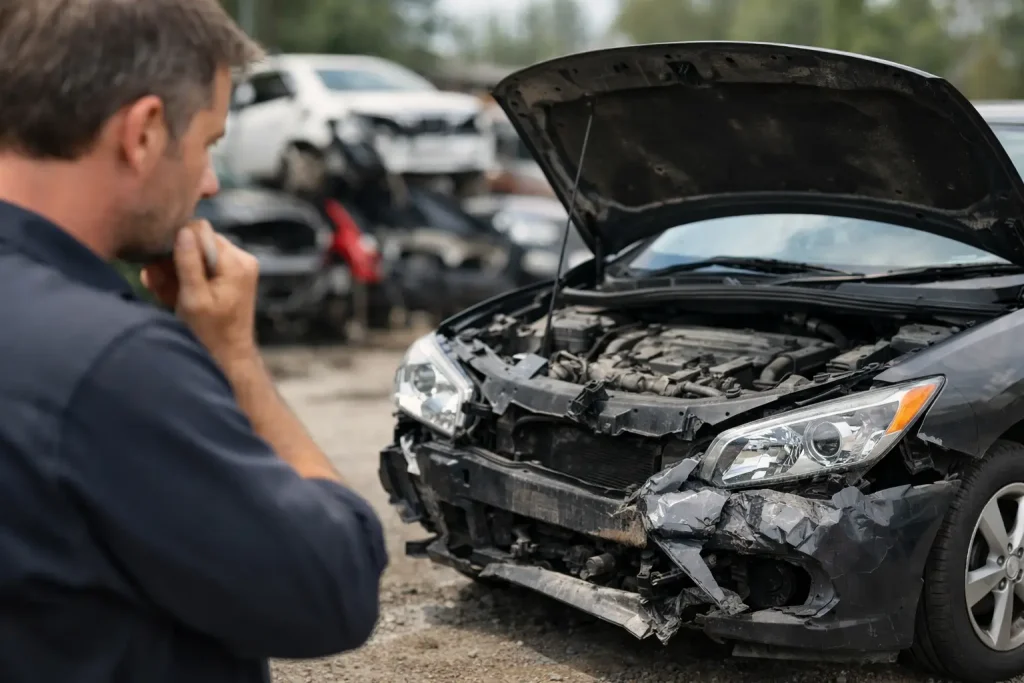
Rust is not just cosmetic when it affects the frame, brake lines, suspension mounts, or floor structure. At that point, safety becomes part of the decision. The same goes for collision damage that affects how the vehicle drives, aligns, or protects passengers.
Once a car has serious structural issues, it may never feel right again even after repair. That matters.
A long list of smaller problems
Sometimes there is no single giant repair bill. Instead, there are six medium ones. Tires are worn, the brakes need work, the check engine light is on, the heater is failing, a window does not close, and the battery keeps dying.
This is where owners get trapped. Each repair seems manageable on its own. Together, they tell a different story. If the vehicle has become a constant project, it is probably past the point of being dependable transportation.
Value matters, but so does reliability
A car can be worth fixing on paper and still not be worth fixing in real life. That is because value is only one part of the decision. Reliability matters just as much.
If you use your vehicle to get to work, transport kids, travel rural roads, or handle winter driving, dependability is not optional. A car that strands you, leaks fluids in the driveway, or keeps failing unexpectedly creates stress that does not show up on a repair estimate.
This is where many owners in places like Salmon Arm, Vernon, or the surrounding Interior communities face a practical choice. If the vehicle is sitting at home because it cannot be trusted, then it is already costing you space, peace of mind, and possibly bylaw headaches too.
When keeping the car makes sense
There are still cases where fixing it is the better move. If the car has been well maintained, has one isolated issue, and is otherwise in solid shape, repair may be cheaper than replacing it. The same is true if you know the vehicle history well and trust that this is not the start of a bigger decline.
A paid-off car with a clean body, decent mileage, and one repairable issue can still be worth saving. The key word is one. Once problems begin stacking, the logic changes.
You should also think about parts availability and repair time. A vehicle that will sit for weeks waiting for parts or repeated shop visits may not be practical even if the repair is technically possible.
Signs you are fixing it out of habit
A lot of people keep an old vehicle longer than they should because they are attached to the idea of getting a few more months out of it. That is common. But if you are honest, there are usually warning signs that the decision is emotional, not practical.
If you keep saying, “I already spent so much on it,” that is a red flag. Money already spent is gone. It should not control the next decision.
If you are avoiding adding up the total cost of the last year of repairs, that is another sign. So is keeping a vehicle parked for months while planning to deal with it “soon.” In many cases, the real decision has already been made. The car just has not left the property yet.
When an unwanted car becomes a property problem
A non-running or uninsured vehicle does not just sit there harmlessly forever. It takes up room, creates an eyesore, and can become a source of complaints or fines depending on where it is parked. On rural properties, it may also turn into a place for leaks, pests, or general clutter to build up.
That is why the question is not only when is a car not worth fixing, but also when is it no longer worth keeping. Those are often the same moment.
If the vehicle has become something you walk around, mow around, or apologize for, it is time to stop treating it like a future project. It is a present problem.
A simple way to make the call
If you are on the fence, ask yourself four direct questions. Is the repair more than the vehicle can justify? Is the car reliable enough after the repair to trust daily? Are there other known issues waiting behind the current one? And is the vehicle taking up space or creating stress right now?
If you answer yes to most of those, you probably already know what to do.
The good news is you do not need to overcomplicate it. Not every old car needs one more chance. Sometimes the smartest move is to stop spending, stop waiting, and get it off the property before it causes more hassle.
For people dealing with a dead or unwanted vehicle in the Shuswap or Okanagan, that is often the most practical path forward. One call really can be the easiest part of the whole situation.
If your car has turned into a money pit, a storage problem, or a source of stress, there is nothing wrong with being done with it.