
If your driveway has turned into a holding area for a car that does not run, a project vehicle that never gets touched, or a second vehicle nobody wants to insure, you are not alone. For many homeowners, how to free up driveway space stops being a simple organizing question and starts becoming a daily frustration every time someone has to shuffle cars, park on the street, or squeeze past clutter.
The good news is that driveway space usually gets eaten up by a small number of problems. Once you identify which one you have, the fix is often more straightforward than people expect.
How to free up driveway space without wasting time
Most crowded driveways are not full because the property is too small. They stay full because one vehicle or one habit has been allowed to sit too long. A car with a blown engine, flat tires, rodent damage, or expired insurance can quietly take over a usable spot for months or even years.
That is why the fastest way to create room is to start with the biggest blocker first. If one dead or unwanted vehicle is taking up the center of your driveway, no amount of rearranging bikes, bins, or seasonal gear will solve the real issue. Remove the thing that makes the whole area hard to use, then decide how to organize what stays.
This matters even more for households with teens, multiple drivers, or frequent visitors. A full driveway adds friction to every day. It also increases the chance of accidental bumps, blocked access, and tension over who has to move what.
Start with the vehicle that should have left already
There is usually one obvious candidate. It is the car that has been parked in the same spot through every season. Maybe it needs expensive repairs. Maybe it failed inspection. Maybe it belonged to a family member and nobody wanted to deal with it. Whatever the reason, it is taking up space now, not someday.
If the vehicle is not being driven and there is no realistic plan to repair it in the next few weeks, keeping it in the driveway is often just delaying the decision. People tell themselves they will get to it when they have more time, but driveway space is too valuable to donate to a stalled plan.
That does not mean every older vehicle needs to go. Some are worth fixing, especially if the repair is minor and the vehicle still fits your needs. But if you are looking at a bad transmission, major electrical issues, heavy body damage, or a car that has sat so long it will need towing anyway, the math changes quickly. In those cases, removal is usually the cleanest way forward.
For homeowners in places like Salmon Arm, Vernon, Kelowna, or Kamloops, this can be especially noticeable when weather changes. Snow, ice, and muddy shoulder seasons make tight parking more than annoying. They make it harder and less safe to use your own property.
Be honest about the true cost of keeping a non-running car
A vehicle parked at home can feel harmless because it is not generating a monthly bill in the same way a storage unit would. But it still has a cost. It takes up a prime parking area, creates visual clutter, and can become a magnet for leaks, pests, and complaints.
There is also the mental load. Every time you pull in and see that dead vehicle, it becomes another unfinished task. For some owners, that task lingers because they assume getting rid of it will be complicated. In reality, the hassle usually comes from waiting, not from dealing with it.
If the car is uninsured, inoperable, or too expensive to repair, holding onto it often makes less sense with time, not more. You are not preserving flexibility. You are preserving a problem.
Use a simple driveway test
If you are unsure what should stay and what should go, ask three practical questions.
First, has the vehicle moved under its own power in the last 60 days? Second, is there a real repair plan with a date and budget attached to it? Third, if the driveway were empty today, would you choose to park that vehicle there again?
If the answer is no to most of those, it is probably not an active vehicle. It is storage. And a driveway is one of the most expensive and inconvenient places to store something you do not use.
How to free up driveway space when you have more than one issue
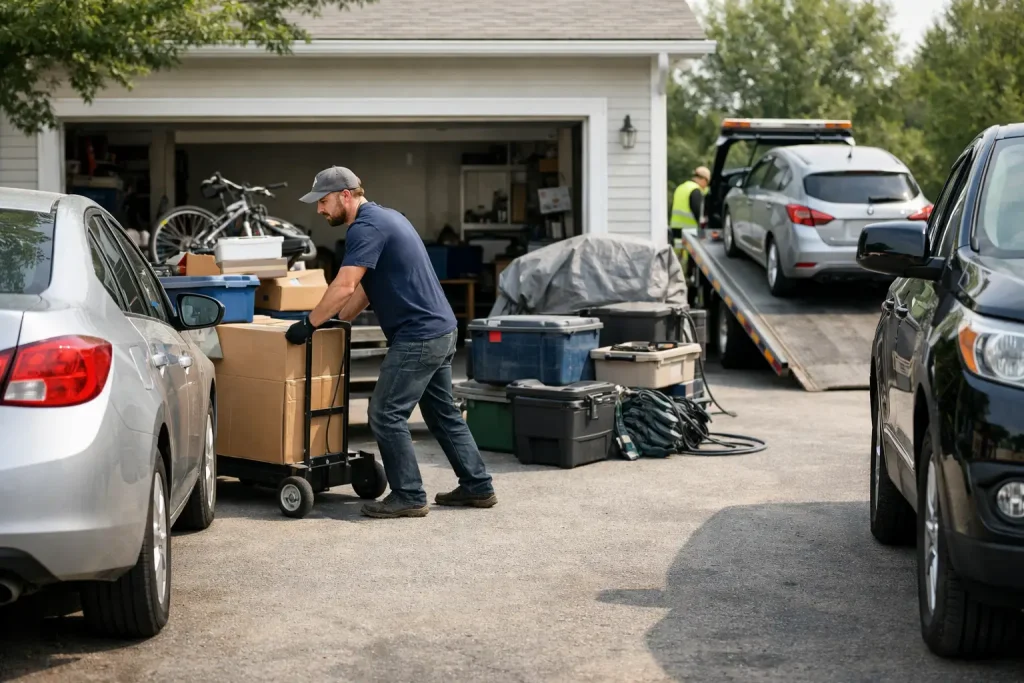
Sometimes the problem is not just one junk vehicle. It is a combination of things: an unused trailer, bins parked in awkward places, a vehicle that only runs sometimes, and a family parking routine that developed by accident.
In that situation, deal with the non-running or unwanted vehicle first. That gives you immediate usable room. Then look at how the rest of the space flows. Can daily-use vehicles park in a way that avoids shuffling? Are there items stored in the driveway because the garage is full of things that should have been cleared out long ago?
This is where people get stuck by focusing on micro-fixes before the main fix. They spend a Saturday reorganizing everything around a vehicle they do not even want. It is better to remove the anchor first and then build a better layout around the space you actually have.
Why driveway clutter becomes a bigger problem over time
A crowded driveway rarely stays the same. It usually gets worse. Once one vehicle becomes permanent, people start working around it. Then parking patterns get sloppy, outdoor storage expands, and the available room shrinks even more.
That is when everyday inconvenience turns into bigger issues. Kids have less room to get in and out safely. Guests end up parking in awkward spots. Snow removal gets harder. Backing out becomes tighter. If neighbors or local bylaws come into play, what started as procrastination can turn into a more urgent problem.
The practical move is to deal with the source early, before it affects the rest of the property.
The fastest fix is often professional removal
If your goal is speed, the fastest answer to how to free up driveway space is usually to have the unwanted vehicle hauled away by a local professional. That is especially true if the vehicle does not run, cannot be insured, or is not worth putting more money into.
Trying to handle it yourself can sound cheaper or simpler at first, but it often drags out. You may need to coordinate towing, paperwork, schedules, and access. Meanwhile the vehicle keeps sitting there.
A local removal company that deals with residential pickups every day can usually make this much easier. One call, a clear pickup plan, and the driveway opens back up without the usual back and forth. For people who just want the problem gone, that is often the difference between action this week and delay for another six months.
That straightforward approach is exactly why many property owners call Scrap Your Car. When a dead vehicle is taking up valuable space, they want it handled quickly, professionally, and without turning it into a bigger project.
What to do after the space is cleared
Once the vehicle is gone, protect that new space from filling back up. Assign spots based on actual daily use, not habit. Keep access lanes clear so no one has to move two cars just to leave the house. If the garage has become overflow storage, this is a good time to reclaim enough room so the driveway does not absorb everything.
You do not need a perfect setup. You need one that works on a busy weekday morning, during bad weather, and when someone comes over unexpectedly. That is the real test.
It also helps to set a firm rule for any vehicle that stops being roadworthy. If it is not getting repaired within a defined window, make a plan to remove it. That one rule can prevent the same problem from returning.
A clear driveway is more useful than people think
Freeing up driveway space is not just about appearances. It makes daily life easier. You get simpler parking, better access, less stress, and fewer obstacles around your home. In some cases, you also reduce the chance of leaks, safety issues, or unwanted attention from bylaws or neighbors.
And there is something else people notice right away once the old vehicle is gone: relief. The property feels easier to manage. Pulling in after work feels normal again. What looked like a small issue often turns out to have been affecting the whole routine.
If a dead or unwanted vehicle is the thing holding your driveway hostage, the best time to deal with it is before another season passes. Open space is useful the minute you get it back.